


Entonox is a fundamental and widely used analgesic in many clinical settings, from the emergency department to the delivery suite. Let's break it down.
What is Entonox?
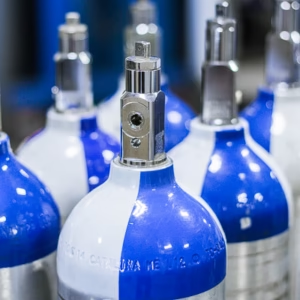 At its core, Entonox is a pre-mixed, colorless, non-flammable gas consisting of 50% nitrous oxide (N₂O) and 50% oxygen (O₂).
It's commonly known by its nickname, "gas and air."
Mechanism of Action
Nitrous oxide acts on the Central Nervous System (CNS) to provide:
- Analgesia: It raises the pain threshold, meaning painful stimuli are less distressing. It doesn't typically eliminate pain completely but takes the "edge" off.
- Anxiolysis: It reduces anxiety and can produce a sense of detachment or euphoria.
Crucially, Entonox is an analgesic, not a full anesthetic. Patients remain conscious, can communicate, and are in control of their own breathing.
The Key Features & Advantages
The real beauty of Entonox lies in its unique pharmacological and practical properties:
- Rapid Onset: The effects are felt within 20-30 seconds of inhalation.
- Rapid Offset: The effects disappear within 2-3 minutes once the patient stops inhaling it and breathes room air (or preferably 100% oxygen). This is because the nitrous oxide is rapidly excreted by the lungs.
- Patient-Controlled Analgesia (PCA): This is its most important safety feature. It is administered via a demand valve. The patient must be conscious and coordinated enough to hold the mask to their face and create a negative pressure by breathing in. Only then does the gas flow.
- Safety implication: If a patient becomes too drowsy, confused, or falls asleep, they will let go of the mask, the negative pressure is lost, and the gas flow stops automatically. This makes an overdose extremely unlikely.
- Non-Invasive: No needles or cannulas are required.
- No Metabolism: For short-term use, it's not metabolized by the body and has no lasting effects on major organs like the liver or kidneys.
Common Uses
Entonox is ideal for short, painful procedures or situations where rapid, temporary pain relief is needed.
- Childbirth (Labor): This is its most famous use, allowing the mother to control her pain relief during contractions.
- Emergency Medicine & Ambulances: For painful injuries like fractures, dislocations (e.g., putting a shoulder back in), and major burns.
- Minor Procedures: Changing painful dressings, draining an abscess, or inserting a urinary catheter.
- Pediatrics: For procedures like suturing in cooperative children.
Contraindications
This is a critical safety section. Entonox is contraindicated in situations where it could be dangerous. The primary concern is its ability to expand any air-filled cavity in the body.
Do NOT use Entonox in patients with:
- Head Injury with Impaired Consciousness: The patient must be able to self-administer. Furthermore, if there is a potential for air to be trapped inside the skull (e.g., after a craniotomy), Entonox could increase intracranial pressure (ICP).
- Pneumothorax: It can expand the air in the pleural space, worsening the collapsed lung.
- Bowel Obstruction or Air in the Gut: It can expand the gas in the intestines, risking perforation.
- Middle Ear Surgery or Infection: It can expand air in the middle ear, causing pain or damage.
- Decompression Sickness ("The Bends"): It is contraindicated in divers who have been underwater in the last 24 hours.
- Severe Vitamin B12 Deficiency: Prolonged or repeated exposure to nitrous oxide can inactivate Vitamin B12, which is critical for nerve function. This is rarely an issue for short-term use but is a consideration for chronic users.
- Inability to Understand/Cooperate: The patient must be able to follow instructions to self-administer safely.
Side Effects
Generally well-tolerated, but some patients may experience:
- Nausea and vomiting
- Dizziness and lightheadedness
- Sedation or a feeling of "drunkenness"
- Disorientation
Diffusion Hypoxia: After stopping Entonox, the nitrous oxide rapidly leaves the blood into the lungs, diluting the oxygen being inhaled. This can cause a temporary drop in blood oxygen levels. Therefore, it is standard practice to give the patient 100% oxygen for a few minutes after they stop using Entonox.
Summary
|
Feature
|
Description
|
|---|---|
| What it is | 50% Nitrous Oxide / 50% Oxygen |
| What it does | Analgesia (pain relief) and Anxiolysis (anxiety reduction) |
| How it's given | Patient self-administers via a demand valve |
| Key Advantage | Rapid onset/offset, patient-controlled, very safe |
| Main Risk | Expansion of air-filled spaces (contraindicated in pneumothorax, bowel obstruction, etc.) |
Entonox is a fantastic tool in the analgesic armamentarium precisely because it is effective, fast-acting, and puts the patient in control of their own pain relief.