IV Giving Sets & Burettes: The Anesthesiologist's Conduits of Care
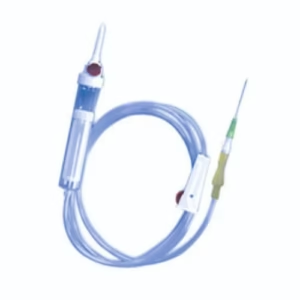 In the dynamic environment of the operating room, the intravenous (IV) line is the patient's lifeline. It is the primary route for fluids, medications, and blood products. The IV giving set and its specialized counterpart, the burette, are not merely passive tubes; they are carefully selected instruments that grant the anesthesiologist precise control over a patient's hemodynamic and physiological state. Understanding their function and application is a fundamental skill in anesthesia practice.
The Anatomy of a Standard IV Giving Set
While seemingly simple, each component of a giving set has a critical purpose: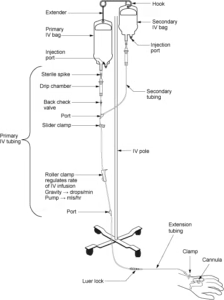
- Spike: Pierces the IV fluid bag port, creating a sterile connection.
- Drip Chamber: Allows the anesthesiologist to visualize the flow rate, count drops for manual rate calculation, and prime the line to remove air.
- Roller Clamp: The primary tool for coarse adjustment of the flow rate in a gravity-fed system.
- Slide Clamp: Acts as an on/off switch, providing a firm and immediate stop to the flow. This is essential for safety when changing bags or accessing the line.
- Injection Ports (Y-sites): These are the critical access points for administering IV drugs "piggyback" style without interrupting the primary fluid infusion.
- Filter: A small mesh filter (typically 15 microns) at the distal end removes any particulate matter or air bubbles before the fluid reaches the patient.
Types of Giving Sets and Their Anesthetic Applications
The choice of giving set is a deliberate decision based on the clinical scenario.
1. Standard Gravity Set
- The Role: The basic, all-purpose set for routine fluid administration.
- Anesthetic Use: Used for maintenance crystalloid infusion (e.g., Lactated Ringer's, Normal Saline) in hemodynamically stable patients undergoing low-to-moderate risk surgery. The anesthesiologist may use the roller clamp to adjust the flow rate manually, often counting drops to achieve a target rate (e.g., 100 mL/hour).
2. Pump-Compatible Set
- The Role: The modern standard for precise, controlled infusion.
- Anesthetic Use: This set is essential for use with volumetric or syringe pumps. It is used for the titratable administration of potent vasoactive drugs like norepinephrine, epinephrine, and vasopressin. It is also used for controlled infusions of sedatives (propofol) and opioids (remifentanil), where exact delivery is paramount to patient stability. These sets are designed to be compliant and non-compliant under pump pressure to ensure accurate delivery.
3. Blood Administration Set
- The Role: The specialized set for safe blood transfusion.

- Anesthetic Use: Distinguished by a much larger filter (170-260 microns) designed to trap clots, cellular debris, and microaggregates from stored blood. The anesthesiologist uses this set whenever administering packed red blood cells, plasma, or platelets, ensuring patient safety during transfusion.
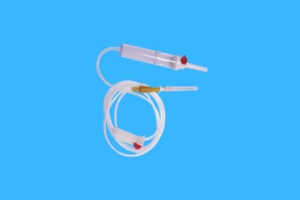
4. Rapid Infuser Set (e.g., Level 1/Haemonetics)
- The Role: The high-volume, high-flow system for massive resuscitation.
- Anesthetic Use: This is a short, wide-bore set designed to be used with a rapid infuser/warming device. It is the cornerstone of management in cases of massive hemorrhage, such as major trauma, aortic surgery, or obstetric hemorrhage. It allows the anesthesiologist to deliver liters of warmed fluid or blood products per minute, rapidly restoring intravascular volume and preventing coagulopathy and hypothermia.
The Specialist: The Burette Set
A burette set is a standard giving set with an added, crucial feature: a calibrated, transparent chamber (typically 100-150 mL) located between the drip chamber and the distal tubing.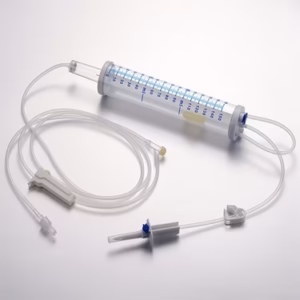
- The Role: To deliver small, precisely measured volumes of fluid over a specific period.
- Anesthetic Use: The burette is an instrument of safety and precision, most commonly employed in two scenarios:
- Pediatric and Neonatal Anesthesia: This is its primary indication. Infants and small children are extremely vulnerable to fluid overload. The burette forces the anesthesiologist to administer fluids in small, controlled "boluses" (e.g., 20 mL), allowing for careful reassessment of the patient's fluid status before giving more. It acts as a safety buffer against accidental over-infusion.
- Precise Fluid Management in Adults: For patients with compromised cardiac, renal, or pulmonary function (e.g., severe heart failure, SIADH), where even a small excess of fluid can be catastrophic. The burette allows for meticulous control of fluid balance.
The burette itself has a micro-drip chamber (delivering 60 drops/mL), allowing for very slow and accurate rates to be set and maintained by gravity alone.
Conclusion
For the anesthesiologist, IV giving sets and burettes are chosen with the same deliberation as a scalpel or a drug. They are the physical conduits through which hemodynamic stability is achieved and maintained. From the standard set for a healthy adult to the burette for a fragile neonate and the rapid infuser for a trauma patient, the selection and management of these tools are a direct reflection of the anesthesiologist's constant vigilance and commitment to patient safety.