From Ether To Present-Day Anesthesia: A Journey Through the History of Anesthesia
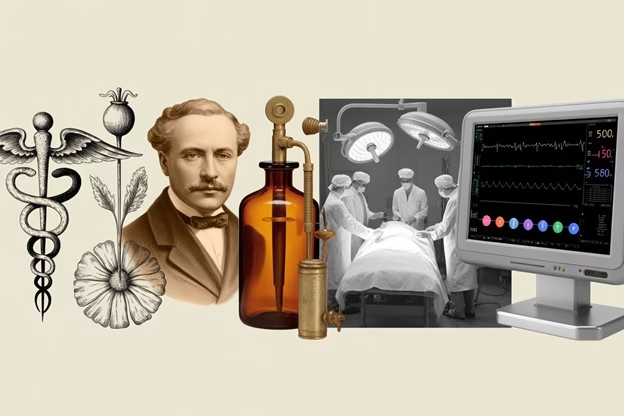
The History of Anesthesia is a riveting narrative of human ingenuity, compassion, and the relentless pursuit of a more humane medical practice. It is a story that transforms surgery from a brutal, last-resort ordeal into a controlled, precise, and life-saving science. Before the advent of effective anesthesia, a patient’s experience on the operating table was one of excruciating pain, sheer terror, and a high likelihood of death from shock. This journey, beginning with the primitive methods of ancient civilizations and culminating in the sophisticated, multi-modal techniques of today, marks one of the most significant revolutions in the history of medicine. This detailed exploration will trace this evolution, from the pivotal discovery of ether to the highly specialized field of modern anesthesiology.
Section 1: The Pre-Ether Era: Ancient and Primitive Attempts
Before the mid-19th century, the concept of rendering a patient unconscious and pain-free for surgery was the stuff of dreams. Surgeons were valued for their speed, not their finesse, as the primary goal was to finish the operation before the patient died from pain-induced shock.
Ancient Remedies and Early Pain Relief
Early civilizations were not without methods for dulling the senses, though they were far from what we would consider true anesthesia.
- Alcohol and Opium: These were perhaps the most common agents. Wine, beer, and spirits were administered liberally to dull the senses and induce a state of stupor. Opium, derived from the poppy plant, was a powerful analgesic known to ancient Sumerians, Egyptians, and Greeks. However, the doses required to produce surgical anesthesia were often dangerously close to lethal.
- Herbal Preparations: Plants like mandrake, henbane, and cannabis were used in various concoctions. Their effects were unpredictable, and the line between sedation and poisoning was perilously thin.
- Physical Methods: Some techniques were shockingly crude. These included inducing cerebral concussion (striking the patient on the head), nerve compression (tourniquets on limbs), and the application of extreme cold. These methods were unreliable and often caused more harm than good.
The Dawn of Modern Surgery and the Need for Anesthesia
By the 18th and early 19th centuries, surgical knowledge was advancing. Anatomical understanding was improving, and new procedures were being conceived. However, this progress was severely hampered by the insurmountable barrier of pain. Surgery remained a terrifying, traumatic event reserved for the most desperate cases. The medical community desperately needed a reliable and safe way to eliminate pain, setting the stage for one of medicine’s greatest breakthroughs.
Section 2: The Ether Revolution: The Public Demonstration that Changed Medicine
The first half of the 19th century saw a flurry of activity in the United States, as several individuals vied for the honor of discovering “pain-killing” gases. This period in the History of Anesthesia is filled with controversy, but it culminated in an event that irrevocably changed the world.
The Contenders: Wells, Morton, and Jackson
- Horace Wells (1815-1848): A Connecticut dentist, Wells was the first to recognize the potential of nitrous oxide (“laughing gas”) for anesthesia. In 1844, he had one of his own teeth extracted while under the influence of the gas and felt no pain. He attempted a public demonstration at Massachusetts General Hospital, but the patient moaned, and the demonstration was deemed a failure, leading to Wells’s ridicule.
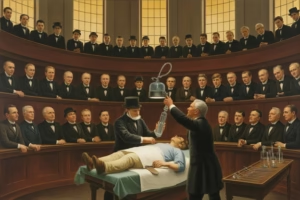
- William T.G. Morton (1819-1868): A former partner of Wells, Morton shifted his focus to ether, a more potent agent. He experimented in secret and, on October 16, 1846, he successfully administered ether to a young man named Gilbert Abbott for the removal of a neck tumor in the surgical amphitheater of Massachusetts General Hospital. The surgeon, Dr. John Collins Warren, famously declared, “Gentlemen, this is no humbug.” This date is now celebrated as Ether Day.
- Charles T. Jackson (1805-1880): Morton’s former mentor, Jackson claimed he had suggested the use of ether to Morton and deserved the credit. A bitter and lifelong feud ensued between Morton and Jackson, tarnishing both their legacies.
The Ether Dome and the Spread of a New Era

The 1846 demonstration, which took place in what is now known as the “Ether Dome,” was a monumental success. News of this “painless surgery” spread like wildfire across the globe, thanks to the new telegraph technology. Within months, surgeons in Europe and around the world were using ether. While it had its drawbacks—it was highly flammable, irritated the lungs, and caused nausea and vomiting—ether was the first truly effective and relatively safe general anesthetic. It gave surgeons the precious gift of time, allowing them to perform longer, more complex, and life-saving operations.
Section 3: The Rise of Chloroform: A Potent Alternative
Just as ether was gaining acceptance, a new, more potent anesthetic emerged from Scotland, offering a more pleasant experience for both patient and surgeon.
James Young Simpson and the Discovery
In 1847, James Young Simpson, a professor of midwifery in Edinburgh, was searching for an alternative to ether. He and his colleagues famously held “sniffing parties” to test various chemical vapors. Upon inhaling chloroform, they were quickly overcome with unconsciousness. Simpson immediately recognized its potential and began using it in his obstetric practice. It was less irritating to the lungs than ether, had a more pleasant smell, and worked faster.
Royal Approval and Widespread Use
Chloroform gained immense popularity, especially in Europe. Its most famous endorsement came in 1853 when Dr. John Snow administered it to Queen Victoria during the birth of her eighth child, Prince Leopold. The Queen’s positive experience silenced many of the religious and moral objections to using anesthesia during childbirth. However, chloroform had a dark side: it had a narrow margin of safety and could cause sudden cardiac arrest and fatal liver damage. This unpredictability eventually led to its decline in favor of safer agents in the 20th century.
Next: The 20th Century Refinement →
Page 1 of 2
Section 4: The 20th Century: Refinement, Specialization, and Safety
The 20th century marks the period where anesthesia transformed from a crude tool into a sophisticated medical specialty. The focus shifted from merely inducing unconsciousness to ensuring patient safety, stability, and optimal surgical conditions.
The Birth of Intravenous Anesthesia
While inhalational agents were the standard, the quest for a smoother, more rapid induction led to the development of intravenous (IV) drugs. In the 1930s, barbiturates like thiopental (known as “sodium pentothal”) were introduced. Administered through an IV, thiopental could induce unconsciousness in seconds, a vast improvement over the slow, suffocating induction with ether masks. This paved the way for modern IV anesthesia techniques.
The Game-Changer: Muscle Relaxants
Perhaps the most significant advancement after ether itself was the introduction of muscle relaxants in the 1940s. Harold Griffith, a Canadian anesthesiologist, was the first to use a purified extract of curare—a plant-based poison used on arrow tips—to induce muscle paralysis during surgery. This was revolutionary. Before, surgeons needed deep levels of anesthesia to make a patient’s muscles relax enough for abdominal surgery. With muscle relaxants, anesthesiologists could keep the patient lightly anesthetized while providing surgeons with perfect operating conditions. This dramatically reduced the physiological stress of surgery.
The Emergence of Anesthesiology as a Medical Specialty
As the science of anesthesia became more complex—with IV drugs, muscle relaxants, and inhalational agents—the role of the administrator evolved. It was no longer a task for a junior doctor or a technician. Highly trained physicians specializing in the field were needed. Professional societies were founded, training programs were established, and anesthesiology was finally recognized as a distinct and vital medical specialty.
The Evolution of Inhalational Agents
Chemists worked to develop better, safer inhalational anesthetics that were non-flammable and had fewer side effects.
- Halothane (1950s): The first modern halogenated volatile anesthetic. It was non-flammable and potent but was later found to cause rare but severe liver damage.
- Isoflurane, Sevoflurane, Desflurane (1980s-1990s): These agents represent the gold standard for modern inhalational anesthesia. They are potent, have minimal side effects, and allow for very rapid recovery, which is crucial for modern outpatient surgery.
Section 5: Parallel Paths: The History of Local and Regional Anesthesia
While general anesthesia was developing, another branch of the History of Anesthesia was unfolding in parallel: the ability to numb specific parts of the body without rendering the patient unconscious.
From Cocaine to Lidocaine
The story of local anesthesia begins with cocaine. In 1884, Karl Koller, an ophthalmologist and colleague of Sigmund Freud, demonstrated that a few drops of cocaine solution could completely numb the surface of the eye, allowing for painless eye surgery. This discovery sparked a revolution. However, cocaine’s addictive properties and cardiovascular toxicity led to a search for safer alternatives. In the early 20th century, chemists developed synthetic local anesthetics like procaine (Novocain) and, later, lidocaine (Xylocaine), which are still widely used today.
Nerve Blocks and Spinal/Epidural Anesthesia
Building on the principle of local anesthesia, physicians developed techniques to block nerves at specific points.
- Spinal Anesthesia: In 1898, August Bier performed the first successful spinal anesthetic, injecting a small dose of cocaine into the spinal fluid to numb the lower half of the body. This is ideal for surgeries on the legs, pelvis, and lower abdomen.
- Epidural Anesthesia: A refinement of the spinal block, the epidural involves placing a catheter in the space outside the spinal dura, allowing for continuous or repeated doses of medication. It became a cornerstone of pain relief during labor (the “epidural”) and is widely used for post-operative pain control.
Section 6: Present-Day Anesthesia: The Age of Precision and Patient Safety

Today, anesthesia is a highly complex and personalized practice. Anesthesiologists are perioperative physicians—the “doctors inside the operating room” responsible for the patient’s well-being before, during, and after surgery.
The Concept of Balanced Anesthesia
Modern general anesthesia is rarely achieved with a single drug. Instead, anesthesiologists use a “balanced anesthesia” approach, a cocktail of different drugs to achieve the desired state. This “triad of anesthesia” includes:
- Hypnosis (Unconsciousness): Achieved with volatile gases (like sevoflurane) or IV agents (like propofol).
- Analgesia (Pain Relief): Achieved with opioids (like fentanyl) and other pain medications.
- Muscle Relaxation: Achieved with muscle relaxants to facilitate surgery.
Advanced Monitoring: The Eyes and Ears of the Anesthesiologist
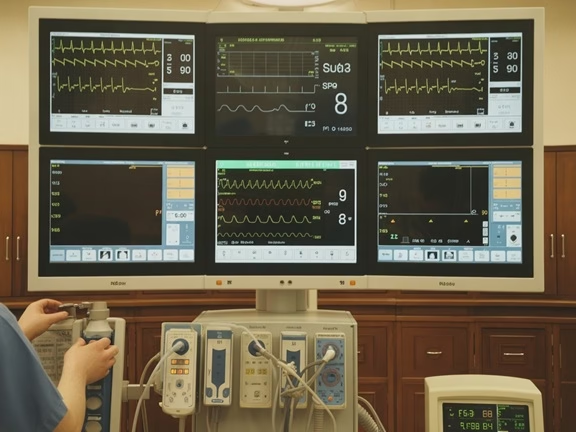
Patient safety has been dramatically improved by sophisticated monitoring technology. Anesthesiologists continuously track a patient’s vital signs, including:
- Electrocardiogram (ECG): Monitors heart rhythm.
- Pulse Oximetry: A small clip on the finger that measures blood oxygen levels, a critical safety device invented in the 1980s.
- Capnography: Measures the concentration of carbon dioxide in a patient’s breath, confirming that the patient is breathing adequately.
- Blood Pressure, Temperature, and Nerve Function: All are meticulously tracked.
Subspecialization and Advanced Techniques
The field has branched into numerous subspecialties, requiring additional fellowship training in areas like cardiac anesthesia, pediatric anesthesia, neuro-anesthesia, and obstetric anesthesia. Advanced techniques like Total Intravenous Anesthesia (TIVA), where the patient is maintained entirely with IV drugs, and Target-Controlled Infusion (TCI), which uses computer models to deliver precise drug doses, are becoming increasingly common.
Beyond the Operating Room: The Role in Pain Management
The expertise of anesthesiologists in pain control has extended far beyond the operating room. They lead Acute Pain Services to manage post-surgical pain and run Chronic Pain Clinics, using a variety of techniques like nerve blocks, spinal cord stimulators, and medication management to help patients suffering from long-term pain.
Conclusion: The Future of Anesthesia
The journey from the first etherized patient to the present-day operating room is a testament to centuries of innovation. The History of Anesthesia is a story of a constant quest for safety, precision, and patient comfort. The future promises even greater advancements. We are on the cusp of a new era involving personalized medicine, where a patient’s genetic makeup may guide drug selection and dosage. Artificial intelligence may assist anesthesiologists in interpreting complex data to predict and prevent complications. And research continues into novel, non-pharmacological methods of inducing altered states of consciousness. From a single, flammable drop of ether to a symphony of drugs, monitors, and skilled physicians, anesthesia has fulfilled its promise: to conquer pain and unlock the full potential of modern surgery.
← Back to Sections 1 – 3
Page 2 of 2