In modern anesthesia, the ability to provide profound muscle relaxation is fundamental to facilitating surgery and securing the airway. Neuromuscular blocking agents (NMBAs) are the drugs that make this possible. However, their use introduces a critical clinical challenge: how does an anesthesiologist precisely gauge the depth of paralysis and, more importantly, confirm its complete reversal? The answer is the Neuromuscular Transmission (NMT) monitor.
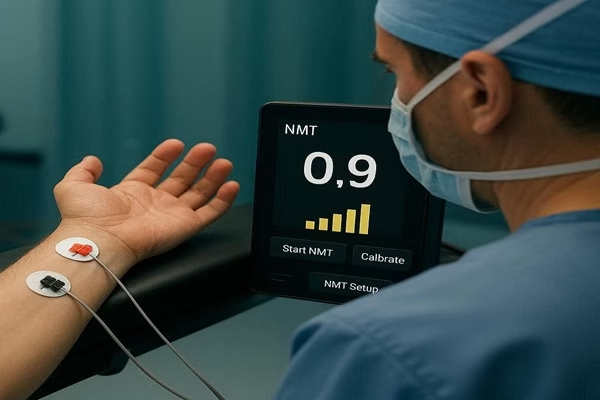
Far from being a supplementary tool, the NMT monitor is an essential piece of equipment that has transformed the management of neuromuscular blockade from an art based on subjective assessment into a precise science, fundamentally enhancing patient safety.
This write-up explores the NMT monitor exclusively from the anesthesiologist's perspective, focusing on its clinical application, interpretation, and integration into the anesthetic workflow.
The "Why": The Clinical Imperatives for Monitoring
The primary reasons an anesthesiologist uses an NMT monitor are to solve three critical problems:
To Prevent Intraoperative Movement: Insufficient paralysis can lead to patient movement, compromising surgical conditions and potentially causing catastrophic injury, especially during delicate procedures like ophthalmic or neurosurgery. The monitor confirms that the level of blockade is adequate for the surgical stimulus.
To Prevent Postoperative Residual Curarization (PORC): This is the most significant safety concern. PORC refers to the presence of residual muscle weakness in the postoperative period. It is not a benign condition and is strongly associated with:
- Airway Compromise: Weak pharyngeal muscles and an impaired cough reflex increase the risk of aspiration and airway obstruction.
- Hypoxia: Weakened respiratory muscles (diaphragm, intercostals) lead to shallow, ineffective breathing and reduced oxygen saturation.
- Patient Distress: Unpleasant symptoms like diplopia (double vision), difficulty swallowing, and generalized weakness can cause significant anxiety and discomfort. Clinical signs alone (e.g., head lift for 5 seconds) have been proven to be insensitive and can miss up to 40% of patients with clinically significant residual blockade. The NMT monitor provides an objective measure to prevent this.
To Guide Rational Drug Administration: NMT monitoring allows for a "dose-on-demand" approach. Instead of giving large, intermittent doses of an NMBA, the anesthesiologist can titrate the drug to the desired effect, minimizing total drug consumption, reducing the risk of cumulative overdose, and potentially shortening recovery time.
The "How": Principles of Stimulation and Interpretation
The NMT monitor works by delivering a controlled electrical current to a peripheral motor nerve and measuring the resulting muscle response. For the anesthesiologist, understanding the stimulation patterns and their interpretation is key.
1. The Stimulation Site:
- Standard: The ulnar nerve at the wrist, with the response measured at the adductor pollicis (thumb). This is the gold standard due to its reliability and accessibility.
- Alternative: The facial nerve (orbicularis oculi muscle) is often used to assess the onset of paralysis, as it responds faster than the adductor pollicis. However, it is not reliable for assessing recovery, as it recovers faster than the muscles of respiration.
2. The Stimulation Patterns (The Anesthesiologist's Toolkit):
Train-of-Four (TOF): This is the workhorse of NMT monitoring. It consists of four supramaximal electrical pulses delivered over 2 seconds.
- During Blockade: The anesthesiologist counts the number of visible or palpable twitches (the "TOF Count"). A count of 0 indicates profound blockade, while a count of 1-4 signifies a progressive return of neuromuscular function.
- During Recovery: The crucial measurement is the TOF Ratio (TOFR), which is the strength of the fourth twitch divided by the strength of the first (T4/T1). In a non-paralyzed state, the ratio is 1.0. Non-depolarizing NMBAs cause a "fade," where T4 is weaker than T1.
- The Magic Number: A TOF Ratio of ≥ 0.9 is the universally accepted objective criterion for adequate recovery of neuromuscular function. This level of recovery correlates with normal airway protection, ventilatory mechanics, and muscle strength required for safe extubation.
Double-Burst Stimulation (DBS): This pattern delivers two short bursts of pulses. It was developed because the fade in the response is easier to feel with one's fingers than the fade in a TOF, making it useful for subjective (tactile) assessment when objective monitoring is unavailable.
Post-Tetanic Count (PTC): Used to assess very deep levels of blockade (when there is no response to TOF). A high-frequency tetanic stimulus is applied, followed by a pause, and then single-pulse stimuli are delivered. The number of twitches that reappear (the PTC) helps the anesthesiologist gauge how deep the block is, which is useful during long, complex surgeries where profound immobility is required.
Integration into the Anesthetic Workflow: A Practical Guide
The NMT monitor is not a "set and forget" device; it is an active tool integrated throughout the perioperative period.
Baseline: After inducing anesthesia but before administering any NMBA, a baseline TOF response is obtained to ensure the equipment is functioning and to establish the patient's control value (TOFR = 1.0).
Intubation: A dose of an NMBA is given. The anesthesiologist uses the monitor (often waiting for a PTC of 1-2 or a sustained TOF count of 0) to confirm a deep enough level of paralysis for optimal intubating conditions.
Maintenance: During surgery, the TOF count is monitored periodically. If the surgical stimulus is high or twitches reappear, a maintenance dose of NMBA is administered. This prevents both under-dosing (risk of movement) and over-dosing (risk of prolonged paralysis).
Reversal and Extubation (The Critical Step):
- Near the end of surgery, the anesthesiologist assesses the TOF count. Once at least 2-3 twitches are present, a reversal agent (e.g., neostigmine) is administered.
- The anesthesiologist then waits. The effect of reversal is not instantaneous.
- The NMT monitor is used to objectively confirm that the TOF Ratio has reached ≥ 0.9.
- Only after this objective confirmation is achieved is the patient considered to have a safe airway and adequate ventilation for extubation.
This sequence—Reversal, Wait, Confirm (TOFR ≥ 0.9), Extubate—is the cornerstone of safe practice and directly prevents PORC.
Subjective vs. Objective Monitoring: A Crucial Distinction
- Subjective Assessment: Involves visually observing or manually feeling the muscle response. While better than nothing, it is highly unreliable, especially at TOF ratios between 0.7 and 0.9. A human cannot reliably detect the subtle fade present at a TOFR of 0.8, a level associated with significant pharyngeal dysfunction.
- Objective Monitoring: Utilizes devices like acceleromyography (the most common modern technology) that measure the actual movement (acceleration) of the thumb. This provides a precise, numerical TOF ratio, removing all guesswork.
The standard of care in modern anesthesia is shifting decisively towards routine objective monitoring. It is the only way to consistently and reliably achieve the TOFR ≥ 0.9 threshold required for patient safety.
Conclusion
For the anesthesiologist, the Neuromuscular Transmission monitor is an indispensable extension of clinical vigilance. It provides the objective data necessary to navigate the delicate balance between surgical paralysis and patient recovery. By guiding drug dosing, preventing intraoperative movement, and—most critically—ensuring the complete and safe reversal of neuromuscular blockade, the NMT monitor is a fundamental tool for optimizing patient outcomes and upholding the highest standards of safety in anesthesia practice.