The Great Awakening: How 19th Century Anesthesia Changed Surgery Forever
Imagine, for a moment, that you are living in the year 1840. You have developed a severe pain on right side of your abdomen. The doctor diagnoses you with appendicitis. Without surgery, you will die. With surgery, you have a fighting chance—but there is a catch.
To save your life, the surgeon must strap you to a wooden table. You will be fully conscious. You will feel the slice of the scalpel, the tear of the muscle, and the sawing of bone. You will likely scream until you pass out from the shock, only to wake up in agony hours later.
For most of human history, this was the terrifying reality of surgery. Surgery was a last resort, a brutal procedure performed at breakneck speed not out of wisdom, but out of mercy.
But then, in the span of just a few decades in the mid-19th century, everything changed. Humanity discovered how to turn off pain.
This is the story of the "Great Awakening"—the introduction of anesthesia.
Before the Mist: The Age of Heroic Surgery
To understand the magnitude of this discovery, we must understand what came before. In the early 19th century, surgeons were not the refined, high-status professionals they are today. They were often associated with barbers and butchers.
The hallmark of a good surgeon was speed.
- Robert Liston, a famous Scottish surgeon, could amputate a leg in under 30 seconds.
- Liston was known for his "three-minute rules." If he took longer, the patient was at risk of dying from shock.
- In his haste, Liston once accidentally amputated his assistant's fingers along with a patient's leg. Both patient and assistant died of gangrene, and a spectator reportedly died of fright. It remains the only surgery in history with a 300% mortality rate.
Pain relief was rudimentary. Doctors used opium, alcohol, or mandrake, but these merely dulbed the senses; they didn't eliminate pain. They often made the patient vomit during the procedure, increasing the risk of choking. Mesmerism (hypnosis) was attempted but was unreliable. Surgery was a screaming, bloody spectacle.
The "Laughing Gas" Era: Horace Wells (1844)
The first major step toward anesthesia began not in a hospital, but at a traveling carnival.
In 1844, a Connecticut dentist named Horace Wells attended a demonstration of nitrous oxide (laughing gas) by a showman named Gardner Colton. During the show, a man under the influence of the gas gashed his leg badly but didn't seem to feel it. Wells noticed the man’s indifference to pain and had a revelation.
The next day, Wells had Colton administer the gas to him while another dentist extracted one of Wells' own teeth. When Wells woke up, he exclaimed, "A new era in tooth-pulling!"
He was ecstatic, but his public demonstration at Massachusetts General Hospital in 1845 was a disaster. The gas bag was removed too soon, the patient groaned in pain, and the audience hissed Wells off the stage as a fraud. Humiliated, Wells left anesthesia, eventually taking his own life a few years later. (He would later be posthumously recognized as a pioneer).
The Ether Demonstration: William T.G. Morton (1846)
While Wells faded, his former partner, William Thomas Green Morton, picked up the torch. Morton, a dentist and businessman, was looking for a way to get ahead. He experimented with sulfuric ether, a highly volatile and flammable liquid.
Morton tested it on his dog, then on himself, and finally on a patient. Confident it worked, he secured a demonstration at the same hospital where Wells had failed: Massachusetts General Hospital.
On October 16, 1846—a date now known as "Ether Day"—Morton administered his anesthetic (which he secretly named "Letheon" to hide the ingredients) to a young man named Gilbert Abbott, who needed a tumor removed from his jaw.
The surgeon was the famous John Collins Warren. As the gas took effect, the patient went limp. Warren cut into the jaw. The operating room was silent. No screaming. No thrashing.
Warren turned to the stunned audience of medical students and spoke the immortal words:
"Gentlemen, this is no humbug."
Surgery changed forever.
The Scottish Discovery: Chloroform (1847)
News of Morton's success spread across the Atlantic via the new telegraph technology. In Edinburgh, a young obstetrician named James Young Simpson was enthusiastic about ether but frustrated by its drawbacks. It smelled terrible, it irritated the lungs, and it was highly flammable (dangerous at a time when surgery was often performed by gaslight).
Simpson and his friends began sniffing various chemicals in their dining room to find an alternative. One night, they tried chloroform. They all passed out on the floor. Upon waking, Simpson realized they had found the winner.
Chloroform was potent, smelled sweet, and was non-flammable. It became the anesthetic of choice in Europe, particularly for childbirth. Its popularity skyrocketed when Queen Victoria used chloroform for the birth of her eighth child, Prince Leopold, in 1853. If the Queen used it, it was acceptable for everyone.
The Dark Side of the Miracle
Despite these miracles, the early days of anesthesia were fraught with danger and controversy.
1. The Lack of Knowledge
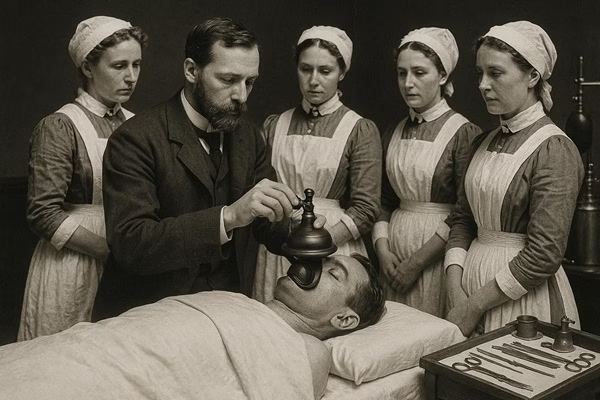
In the 19th century, doctors did not understand how to monitor vital signs. There were no EKGs or pulse oximeters. Anesthesia was administered by simply dripping the liquid onto a rag or sponge and holding it over the patient's face until they stopped moving. If the patient died, it was often attributed to "shock" or a weak constitution, rather than an overdose.
2. The Ether vs. Chloroform Wars
A fierce rivalry sprang up between American and British doctors. Americans generally preferred Ether (it was harder to kill a patient with it, though it was unpleasant), while the British favored Chloroform (it was faster and more pleasant, but had a narrow safety margin). The debate raged for decades.
3. The Religious Objection
Surprisingly, there was significant religious pushback. Many clergymen argued that pain was divinely ordained. Genesis states that Eve’s punishment for the Fall was pain in childbirth. To use chloroform to alleviate that pain was seen by some as interfering with God's will. (Queen Victoria’s use of the drug helped silence this argument).
The Legacy: The Birth of Modern Surgery
The introduction of anesthesia did more than stop pain; it fundamentally rewrote the rules of medicine.
- From Speed to Precision: Surgeons no longer had to race the clock. They could slow down. They could dissect tissues carefully, tying off blood vessels to prevent bleeding. This allowed for complex operations on the abdomen, the brain, and the chest—places previously off-limits.
- Antiseptics and Asepsis: Because anesthesia allowed operations to take longer, the risk of infection actually increased initially. This forced the hand of pioneers like Joseph Lister, who introduced carbolic acid to kill germs. Anesthesia made antiseptic surgery necessary, and together, they made modern surgery possible.
- Specialization: Surgery became an intellectual discipline, distinct from barbering. It required knowledge of physiology and chemistry.
Conclusion
By the end of the 19th century, the scream had vanished from the operating theater. The brutality of the knife had been replaced by the quiet of the operating room.
The story of 19th-century anesthesia is not just a history of chemistry; it is a story of humanity. It represents the moment when we decided that suffering was not an inevitable part of the human condition, but a problem to be solved. It was the first great gift of modern medicine to the world: the gift of mercy.