Clinical Frailty Scale (CFS)

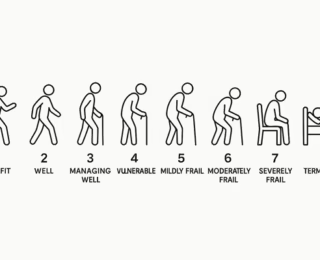
9-Point Clinical Frailty Scale

The Clinical Frailty Scale (CFS) assesses a patient’s physiological reserve beyond their chronological age. This vital tool predicts vulnerability to surgical stress, postoperative complications, and recovery speed, enabling better risk stratification and informed decision-making for older surgical patients.

Continue reading

ASA Physical Status (PS) Classification System

Anesthesiologist doing ASA classification

The ASA Physical Status Classification System is a critical tool for assessing a patient’s overall health before anesthesia. This detailed guide breaks down the six classes, providing clear definitions and examples to help clinicians accurately stratify patient risk and improve communication.

Continue reading

Tele-Anesthesia and Remote Monitoring

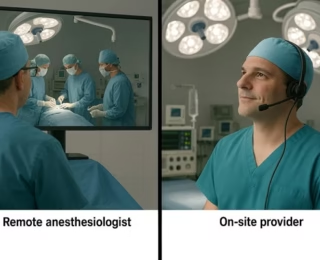
Remote monitoring by an anesthesiologist

Tele-anesthesia leverages high-speed networks and AI to deliver expert anesthesia care from a distance. From a central command center, anesthesiologists can provide real-time oversight for multiple operating rooms, enhancing patient safety and democratizing access to specialist expertise in rural hospitals and ambulatory surgery centers.

Continue reading

Bispectral Index (BIS) Monitor

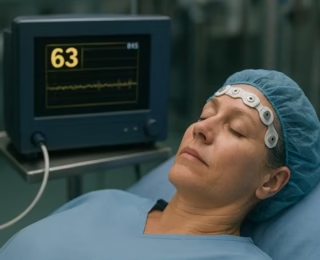
BIS monitor

The BIS monitor analyzes brain EEG waves to create a single number (0-100) indicating a patient’s consciousness level. It helps clinicians precisely titrate anesthetic drugs, preventing intraoperative awareness while avoiding oversedation, leading to safer, faster recovery for patients undergoing surgery or sedation.

Continue reading

Cardiac Output Monitor

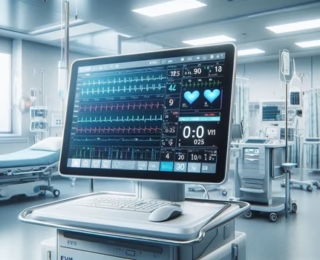
EV 1000 in ICU

Minimally invasive monitors like FloTrac and EV1000 analyze arterial waveforms to deliver continuous cardiac output data. This real-time insight is vital for guiding fluid and drug therapy in critically ill patients, offering a powerful, less-risky alternative to traditional pulmonary artery catheters for hemodynamic management.

Continue reading

Goal-Directed Fluid Therapy (GDFT)

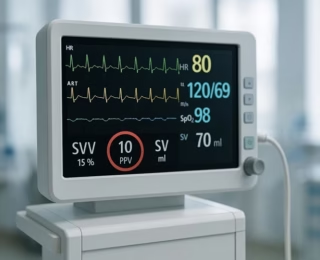
ICU monitor displaying Dynamic Vitals

Goal-Directed Fluid Therapy (GDFT) is a modern, evidence-based approach that marks a fundamental shift from traditional fluid management. Instead of relying on static, often misleading parameters like central venous pressure (CVP), GDFT uses real-time, dynamic monitoring to personalize fluid delivery for each patient.

Continue reading

Opioid-Sparing and Opioid-Free Anesthesia (OFA)

Opioid-Sparing and Opioid-Free Anesthesia uses a multimodal approach—combining regional blocks and IV medications like ketamine and lidocaine—to minimize opioid use. This strategy reduces side effects like nausea and ileus, leading to faster recovery and less risk of chronic postoperative pain.

Continue reading

Enhanced Recovery After Surgery (ERAS): A Detailed Overview

Early Mobilisation of Patient(ERAS)

Enhanced Recovery After Surgery (ERAS) is a multidisciplinary, evidence-based pathway that minimizes surgical stress. Through coordinated protocols across the perioperative period, it accelerates recovery, reduces complications, and shortens hospital stays, fundamentally improving patient outcomes and experience.

Continue reading

Esmolol

Esmolol Injection

Esmolol is an ultra-short-acting, cardioselective, beta-1 adrenergic receptor antagonist. Its ultra-short duration of action makes it uniquely suited for the dynamic environment of the operating room.

Continue reading