


Crack ‘The Core’ - 9 Key Sections Every Anaesthesia Student Should Master
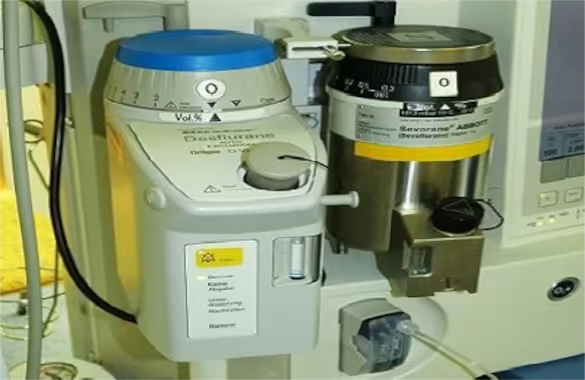
INSTRUMENTS & EQUIPMENT USED DURING ANESTHESIA

ANESTHESIA PHARMACOLOGY & DRUGS
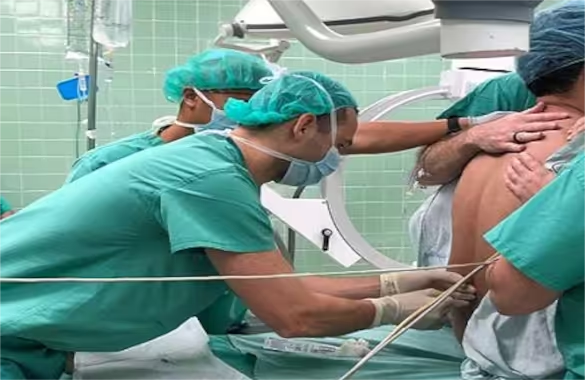
PROCEDURES IN ANESTHESIA PRACTICE

PRESENTATIONS IN ANESTHESIOLOGY
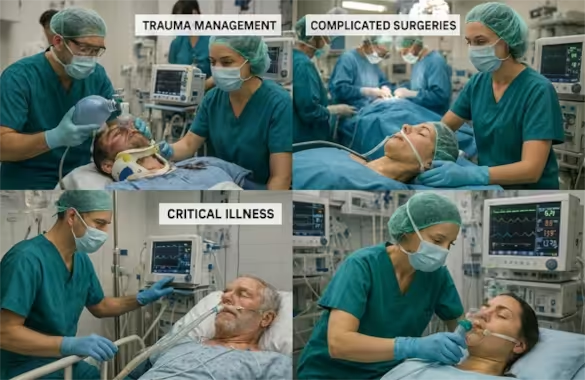
CLINICAL SCENARIOS DURING ANESTHESIA
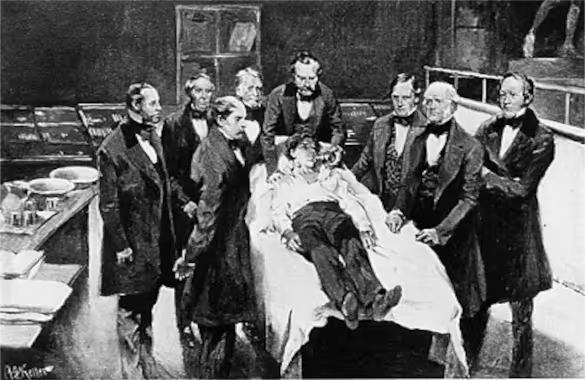
HISTORY OF ANESTHESIA

ANESTHESIA CLINICAL CALCULATOR
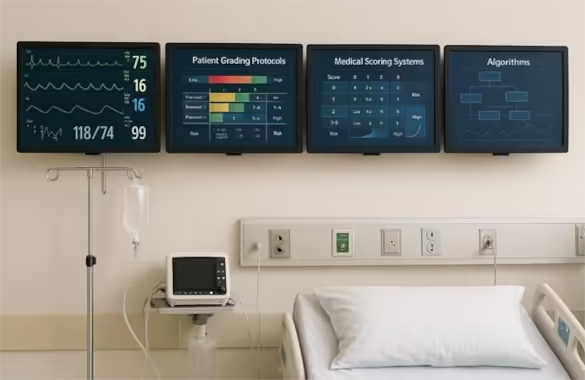
SCORING AND GRADING IN ANESTHESIA
Anesthesia Machine & Anesthesia Workstation
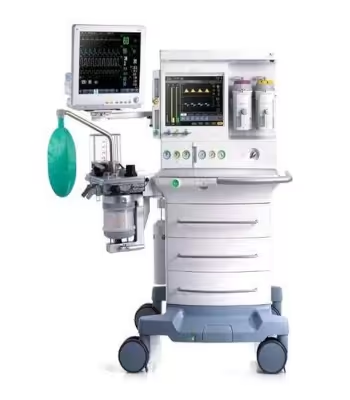 Welcome to the nerve center of the operating room. The anesthesia workstation, with its complex array of dials, circuits, and monitors, can seem like an intimidating beast. But what if you could master it? This comprehensive resource is your guide on a fascinating journey—from the historic, clunky elegance of the Boyle's machine to the sleek, intelligent workstations of Dräger, GE, and Mindray that define modern practice. We will demystify the physics, deconstruct the components, and build your confidence. This isn't just about learning a machine; it's about understanding your most critical partner in ensuring patient safety.
Our journey will be a methodical one. We'll start by laying a strong foundation, exploring the history and the core physics that govern every machine. From there, we'll build up your knowledge piece by piece, dissecting the classic anatomy of an anesthesia machine and mastering the circle breathing system. Only then will we leap into the modern era, comparing the sophisticated features of today's leading workstations. Each module is designed to build upon the last, transforming a daunting subject into a clear, manageable, and ultimately, masterable skill.
Women in Anaesthesia History
Women have shaped anaesthesia since its beginning. Alice Magaw pioneered safe practice at the Mayo Clinic. Virginia Apgar revolutionised neonatal care with her famous score. Early pioneers faced fierce opposition. Professional societies excluded women for decades. Today, women are a training majority. Nevertheless, leadership gaps persist. Women in anaesthesia deserve recognition and equity.
The Anaesthesia History of the Developing World
Colonial powers introduced anaesthesia but neglected training. Independence brought medical schools and local pioneers. Non-physician anaesthetists deliver most care today. Regional anaesthesia and ketamine are essential. WHO promoted safety through checklists. The Lancet Commission (2015) called for action. Anaesthesia in developing world has improved but remains a critical challenge worldwide.
The History of Pain Medicine
Pain is the oldest medical problem. For centuries, chronic pain was dismissed as imaginary. John Bonica, the “father of pain medicine,” founded the International Association for the Study of Pain in 1973 and established multidisciplinary pain clinics. Melzack and Wall’s gate control theory (1965) revolutionised understanding. Pain medicine was formally recognised as a subspecialty in 1991, evolving from anaesthesiology’s cradle.
The Development of Paediatric Anaesthesia
Children are not small adults. The development of paediatric anaesthesia recognised this truth. Pioneers such as Smith and Stephen established dedicated services, training, and research. Specialised equipment and techniques—including sevoflurane induction—improved safety. Today, paediatric anaesthesia is a well-established subspecialty, ensuring that the most vulnerable patients receive the specialised care they deserve.
The Evolution of Anaesthesia as a Critical Care Specialty
The Copenhagen polio epidemic of 1952 was a turning point. Bjørn Ibsen’s use of positive-pressure ventilation reduced mortality from 80-90% to 40%. Anaesthetists brought their skills—airway management, ventilation, haemodynamic support, resuscitation—to critical care. Peter Safar developed CPR. The ICU emerged as a distinct specialty, with anaesthetists at its heart, saving countless lives.
The Machinery of Anaesthesia
The first anaesthetic “machine” was an ether-soaked rag. John Snow introduced precision inhalers in the 1840s. Henry Boyle’s 1917 machine brought standardization. Carbon dioxide absorption enabled closed-circuit anaesthesia. The Copper Kettle vaporizer (1952) allowed precise delivery of potent agents. Today’s integrated workstations represent a century of innovation—each improvement making anaesthesia safer and more controllable.
Capnography
Capnography, the window to the airway, has its origins in John Tyndall’s 1860s discovery that carbon dioxide absorbs infrared radiation. The first clinical analyser appeared in the 1940s, but capnography only became routine in the 1990s. It confirms endotracheal tube placement, detects hypoventilation, and reveals airway obstruction—essential monitoring that has transformed the safety of anaesthesia.
Pulse Oximetry
Before pulse oximetry, anaesthetists could not reliably monitor oxygenation. Takuo Aoyagi’s 1972 discovery of the pulsatile light absorption principle changed everything. The first commercial pulse oximeter appeared in 1975. Today, pulse oximetry is the fifth vital sign, essential in every operating theatre worldwide—a simple, non-invasive technology that has saved countless lives.
Disclaimer!
The information provided on this platform, including but not limited to articles, case studies, clinical scenarios, guidelines, and multimedia content, is intended for educational and informational purposes only.
The authors and editors of this material have made every effort to ensure the accuracy of treatments, drugs, and dosage regimens that conform to currently accepted standards. However, due to continual changes in information resulting from ongoing research and clinical experience, unique aspects of individual clinical situations, as well as the potential for human error; readers must exercise personal judgment when making a clinical decision.
This website may contain third-party information or links to other internet websites. We do not control nor assume responsibility for any third-party content provided nor content on linked Internet websites.
We strongly recommend the visitors of this website to go through its Detailed 'Disclaimer' and 'Terms of Use'.
By accessing, browsing, or using this website, you acknowledge that you have read, understood, and agreed to be bound by the 'Disclaimer' and 'Terms of Use'. If you do not agree with these terms, you must NOT use this website.