


Crack ‘The Core’ - 9 Key Sections Every Anaesthesia Student Should Master
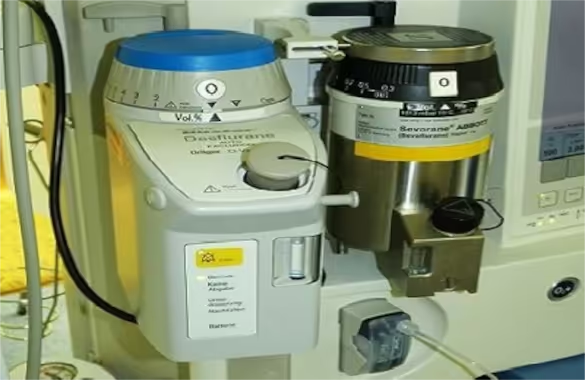
INSTRUMENTS & EQUIPMENT USED DURING ANESTHESIA
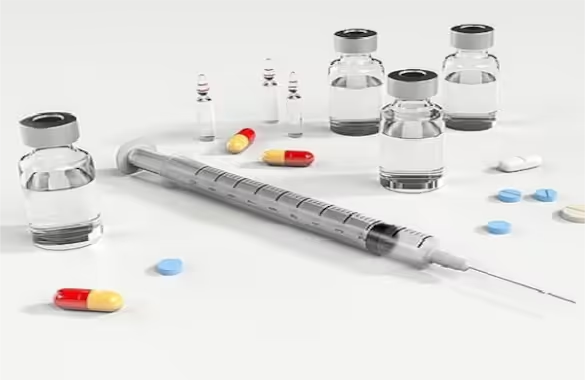
ANESTHESIA PHARMACOLOGY & DRUGS
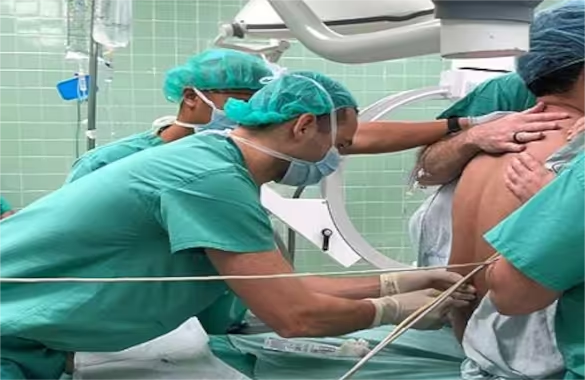
PROCEDURES IN ANESTHESIA PRACTICE
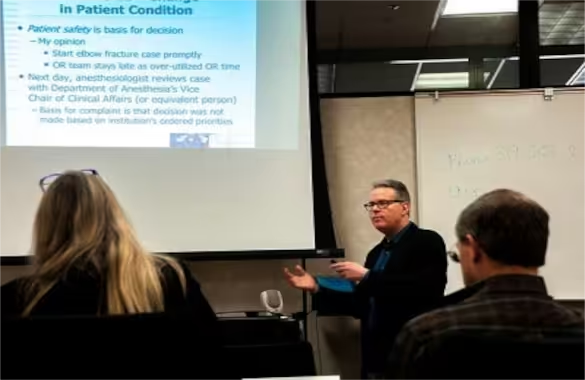
PRESENTATIONS IN ANESTHESIOLOGY
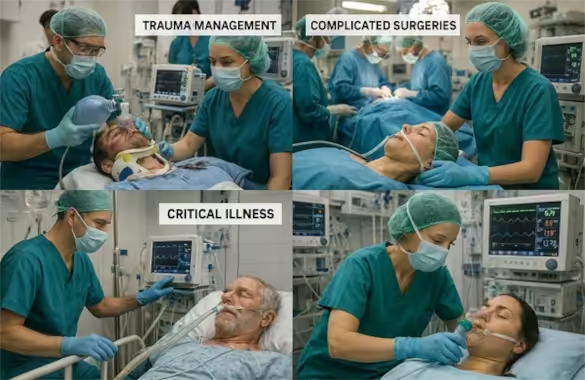
CLINICAL SCENARIOS DURING ANESTHESIA
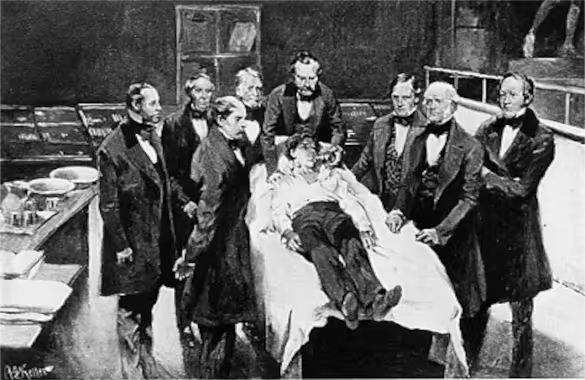
HISTORY OF ANESTHESIA

ANESTHESIA CLINICAL CALCULATOR
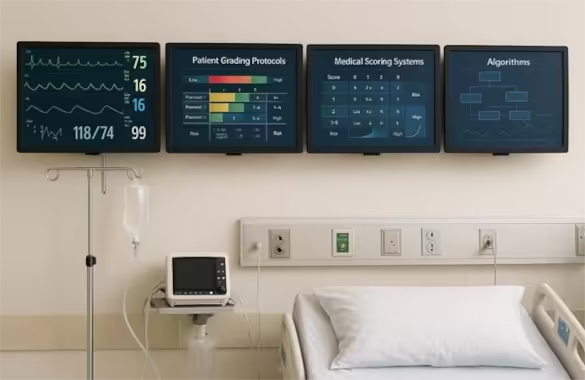
SCORING AND GRADING IN ANESTHESIA
Anesthesia Machine & Anesthesia Workstation
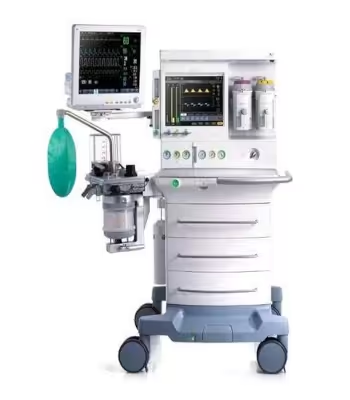 Welcome to the nerve center of the operating room. The anesthesia workstation, with its complex array of dials, circuits, and monitors, can seem like an intimidating beast. But what if you could master it? This comprehensive resource is your guide on a fascinating journey—from the historic, clunky elegance of the Boyle's machine to the sleek, intelligent workstations of Dräger, GE, and Mindray that define modern practice. We will demystify the physics, deconstruct the components, and build your confidence. This isn't just about learning a machine; it's about understanding your most critical partner in ensuring patient safety.
Our journey will be a methodical one. We'll start by laying a strong foundation, exploring the history and the core physics that govern every machine. From there, we'll build up your knowledge piece by piece, dissecting the classic anatomy of an anesthesia machine and mastering the circle breathing system. Only then will we leap into the modern era, comparing the sophisticated features of today's leading workstations. Each module is designed to build upon the last, transforming a daunting subject into a clear, manageable, and ultimately, masterable skill.
Hunt & Hess Scale
The Hunt & Hess Scale grades subarachnoid haemorrhage severity from Grade I (mild headache) to Grade V (deep coma). Grades III-V carry higher mortality and require urgent intervention. Anaesthesia trainees must use this scale alongside GCS and pupillary assessment to guide perioperative management, monitoring intensity, and postoperative destination in neurocritical care.
Glasgow Coma Scale
The Glasgow Coma Scale (GCS) assesses consciousness through Eye opening (1-4), Verbal response (1-5), and Motor response (1-6). Total score ranges from 3 (deep coma) to 15 (fully alert). Components must be recorded individually (E4V5M6). Score ≤8 suggests coma and may indicate airway protection needs for anaesthesia trainees.
Cormack-Lehane Grading
The Cormack-Lehane grading system classifies laryngeal view during direct laryngoscopy: Grade I (full glottis view), Grade II (partial view, subdivided into IIa and IIb), Grade III (only epiglottis visible), and Grade IV (no laryngeal structures visible). It guides real-time intubation decisions and future anaesthetic planning for trainees.
LEMON Airway Assessment
The LEMON mnemonic guides systematic airway assessment: Look externally for difficult airway features; Evaluate 3-3-2 (mouth opening, thyromental distance, hyoid-mental distance); Mallampati score; Obstruction or obesity; and Neck mobility. It provides rapid, structured evaluation for anaesthesia trainees, though no assessment predicts all difficult airways.
Mallampati Score
The Mallampati score classifies oropharyngeal visibility to predict intubation difficulty. Classes range from I (full view of pillars, uvula, and soft palate) to IV (only hard palate visible). Perform with patient seated, tongue protruded, without phonation. Use alongside other airway assessments—never alone.
Henry Boyle
Henry Boyle developed the iconic Boyle anaesthetic machine, modifying an American design. His continuous-flow apparatus delivered nitrous oxide, oxygen, and ether accurately. He also introduced the Boyle-Davis gag for tonsillectomy. His machine became synonymous with British anaesthesia, remaining in production for many decades.
Ivan Magill
Ivan Magill revolutionised airway management through blind nasal intubation and his eponymous forceps and tubes. Working with facial injury patients, he developed techniques that secured the airway without direct vision. His innovations remain essential tools in modern anaesthesia. He was a founder of the Association of Anaesthetists and lived to ninety-eight.
Sir Robert Macintosh
Sir Robert Macintosh revolutionised airway management with his curved laryngoscope blade, introduced in 1943. He became Oxford’s first professor of anaesthesia and trained a generation of leaders. His wartime service, international teaching, and relentless advocacy elevated anaesthesia. His blade remains the global gold standard for tracheal intubation today.
Disclaimer!
The information provided on this platform, including but not limited to articles, case studies, clinical scenarios, guidelines, and multimedia content, is intended for educational and informational purposes only.
The authors and editors of this material have made every effort to ensure the accuracy of treatments, drugs, and dosage regimens that conform to currently accepted standards. However, due to continual changes in information resulting from ongoing research and clinical experience, unique aspects of individual clinical situations, as well as the potential for human error; readers must exercise personal judgment when making a clinical decision.
This website may contain third-party information or links to other internet websites. We do not control nor assume responsibility for any third-party content provided nor content on linked Internet websites.
We strongly recommend the visitors of this website to go through its Detailed 'Disclaimer' and 'Terms of Use'.
By accessing, browsing, or using this website, you acknowledge that you have read, understood, and agreed to be bound by the 'Disclaimer' and 'Terms of Use'. If you do not agree with these terms, you must NOT use this website.